Gamechangers

A Bad Day for Maritime UAVs

By Dr. Richard Weitz
A major attraction-getter at this week’s Farnborough International Air Show, the biennial aviation event in southern England at which representatives from SLD attended, was a video displaying a laser weapon downing four unmanned aerial vehicles flying over the water. The tests represented the first time that a ship-based solid-state laser has shot down an aircraft mid-flight over water.

Read More

Crafting a New Paradigm for Manned-Unmanned Systems: Lieutenant-General Deptula Reflects on the MQ-X

Interview With Lieutenant-General Deptula
“We are moving into an era that is much different than the one we just left. Now, that might seem obvious; but moving from the 20th to the 21st century was not just a convenient break point, but it is moving away from the industrial age of conducting warfare into an information age to a degree that is only going to accelerate.”

Read More

An Update on the Distributed Aperture System

An Interview With Mark Rossi, Northrop Grumman Electronic Systems
“The biggest problem facing DAS is the fact that it is a complete unknown to most people, but as they become more familiar with its value, they begin to realize just how revolutionary this system will be for the warfighter. DAS changes the game. If you consider radars for instance, the utility radar brings to the fight has been fundamental to the mission of our armed forces for decades.”

Read More

The US Space Strategic Environment 2020: Coping with Multi-Polar Space

No matter what the U.S. does, multi-polar space will create new policy realities. There will be alternatives to working with the U.S. for human and robotic space explorations. There will be alternative constellations to U.S. global positioning systems. And Europe, India, China, India and Japan will all have capabilities, which can operate as iron magnates attracting the iron filings of space activities. Space will become a multiple Venn diagram of activity.

Read More

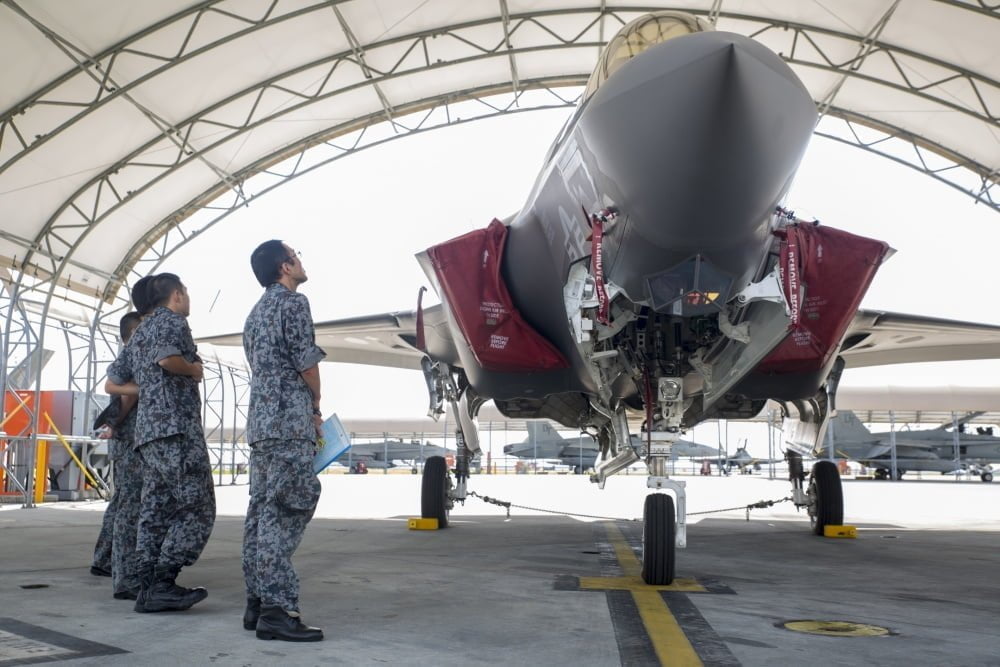
The F-35B in the Perspective of Aviation History

BY ED TIMPERLAKE
With the very real capability of three dimensional sensing and being able to distribute information to other warfighers, airborne and on the ground or at sea the relationship of the individual pilot to knowledge of the bigger air battle is truly revolutionary—this is brand new and to undergo further developments.

Read More

Russia is Losing Its Chinese Arms Market

BY RICHARD WEITZ, HUDSON INSTITUTE
Earlier this month, Russia’s English-language RT television broadcasted a story about how China had violated international copyright laws and copied one of Russia’s most lucrative military export items—the Sukhoi-27 fighter…. Russia gave China’s defense industry the plane’s designs in 1995, after the PRC agreed to purchase 200 kits to assemble the plane in China under license. But after building 100 planes, in 2004 the Chinese cancelled the contract for the remaining 100 kits on the grounds that the plane no longer met the Chinese Air Force’s increasingly stringent performance requirements.

Read More

Mark Lewis on Hypersonics: Taking a Logical Path

When NASA’s X-43 flight test vehicle separated from its Pegasus rocket booster and accelerated to high-Mach speeds powered by an air-breathing scramjet, the premise and promise of hypersonic flight were forever validated. With a first Mach-7 flight in March 2004, followed by a Mach-10 flight in November 2004, the hydrogen-burning X-43 vehicles were the culmination of nearly five decades of research in hypersonic air-breathing flight.
Next month, if all goes well, the next chapter in hypersonics will be written, as the U.S. Air Force’s X-51 vehicles begin their own series of flight tests.

Read More

Game Changers: Reframing The Climate Change Debate (Part Three)

NASA scientists say that Mars has warmed by about 0.5°C since the 1970s. This is similar to the warming experienced on Earth over approximately the same period. Given that there is no known life on Mars, simultaneous warming on Mars and Earth suggests that our planetʼs recent climate changes may have a more natural cause and a less man-made cause.

Read More

Game Changers: Reframing The Climate Change Debate (Part Two)

The longer the sun remains quiet, the higher the chances of a prolonged series of cold winters and shorter summers. This is the quietest sun we have seen in almost a century.The current solar cycle, which began in 1996, was expected to reach a minimum and transition to a new solar cycle in January 2007, post 11 years. It did not, although we have crossed 13+ years and are still counting in January 2010. We are experiencing a historically deep solar minimum!

Read More

Gamechanger Series: Reframing The Climate Change Debate (Part One)

Is the bitter winter afflicting much of the Northern Hemisphere the start of a global trend towards much cooler weather that is likely to last in the longer term? (…) As the deep freeze continues across Europe, Asia and North America, conventional wisdom insists that this is merely a ‘blip’ of no long-term significance…

Read More
Send articles as PDF to

©2010 sldInfo. All rights reserved. Terms & Conditions.