

2017-11-16 By Todd Miller
Regardless the virtues of the platform, Textron Defense Aviation LLC’s approach to build an aircraft tailored to military operations where no stated requirement exists is rare and risky.
However, it is not risk taken in a vacuum, but rather an example of entrepreneurship that was inspired by the thought leadership of the USAF and military aviators.
Aside the absence of an official requirement, reviews of articles penned and speeches made by leaders of the USAF reveal the basis for design of the Scorpion and the Textron model.
USAF leadership defines an Air Force that; utilizes Fusion Warfare; the Combat Cloud; Open Architecture; Non-proprietary system contracts; the Information Battlespace; addresses the pilot shortage; operates much more cost effectively with a high/low platform mix that generates airframe and fuel savings (see Logistical Fratricide); and empowers Decision Superiority.
The Scorpion addresses each of these operational concepts/issues and brings additional capabilities to the deploying Air Force (the USAF or any number of its allies).
As such, the platform not only serves an immediate need, it contributes to shaping an approach for future weapons systems development.
Absent the design philosophy many find the Scorpion an enigma.
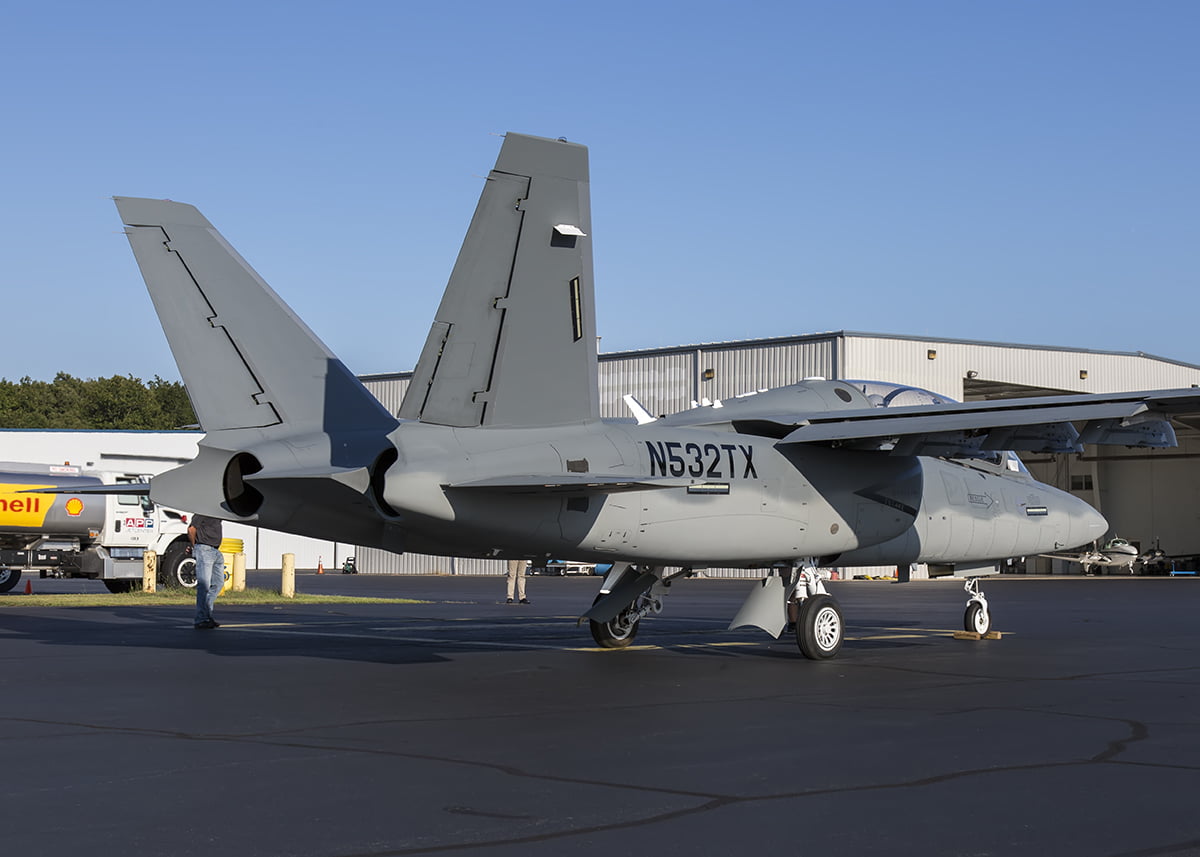
Though it has capability overlap, the Scorpion is not a traditional Fighter, Attack, Reconnaissance, Observation, or Trainer, nor is it designed to replace any existing platform. To understand it, one must look to the Scorpion as a ISR/Strike platform developed in the context of the smartphone business model.
The hardware platform – the Scorpion, could be likened to the 256 GB iPhone X (or equivalent Pixel 2/Samsung Note 8 if you prefer).
The aircraft features a truly open mission architecture, with extraordinary internal/external payload capability. An Interface Control Document [ICD] is made available to payload suppliers who program their payloads to interface with the Scorpion mission system.
The result is a very efficient hardware platform with a very flexible approach to the applications/payloads which might be carried onboard the platform.
Textron focuses on providing the very low operating cost, flexible, and modular “flying platform” to readily host a variety of payloads.
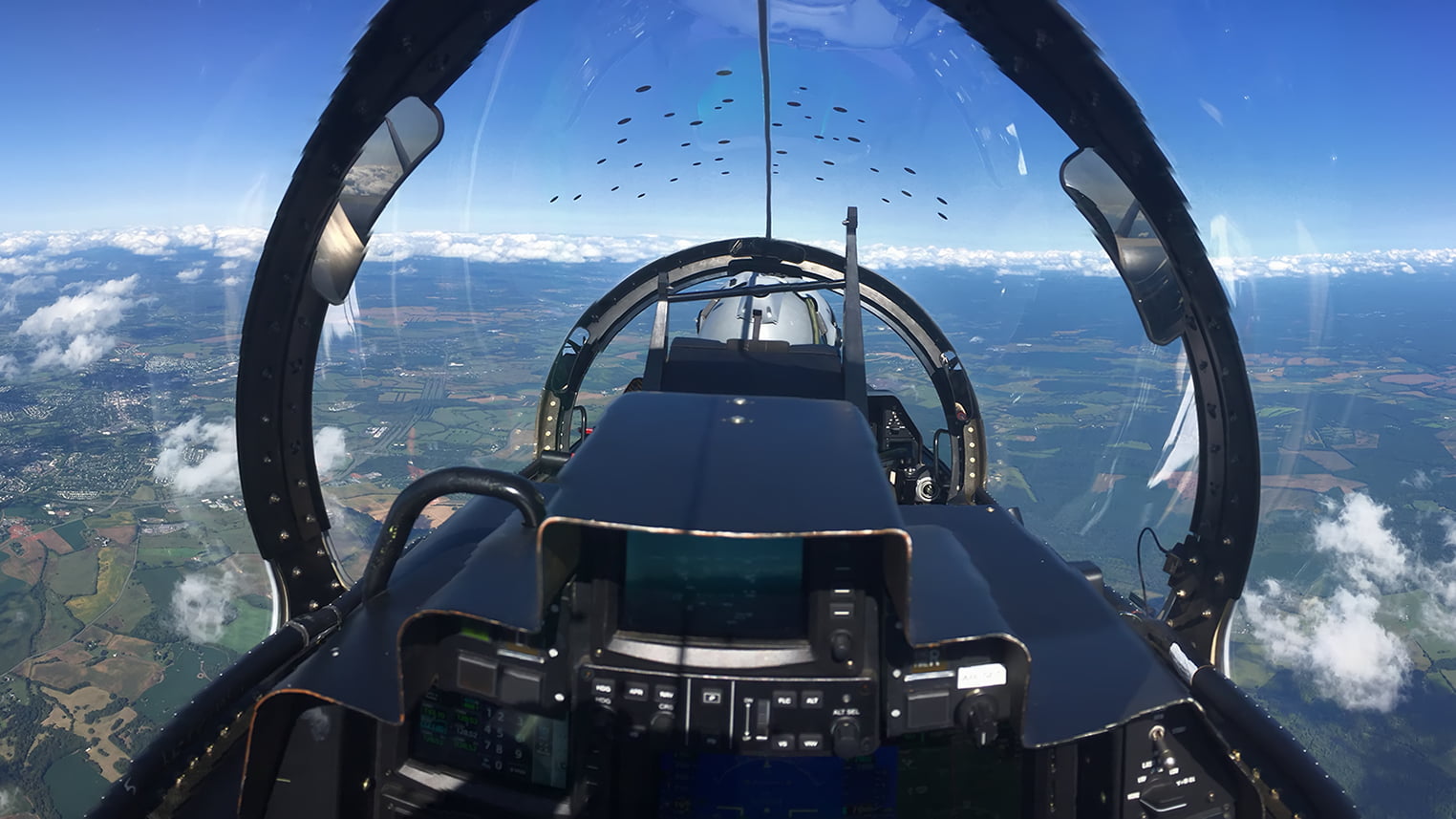
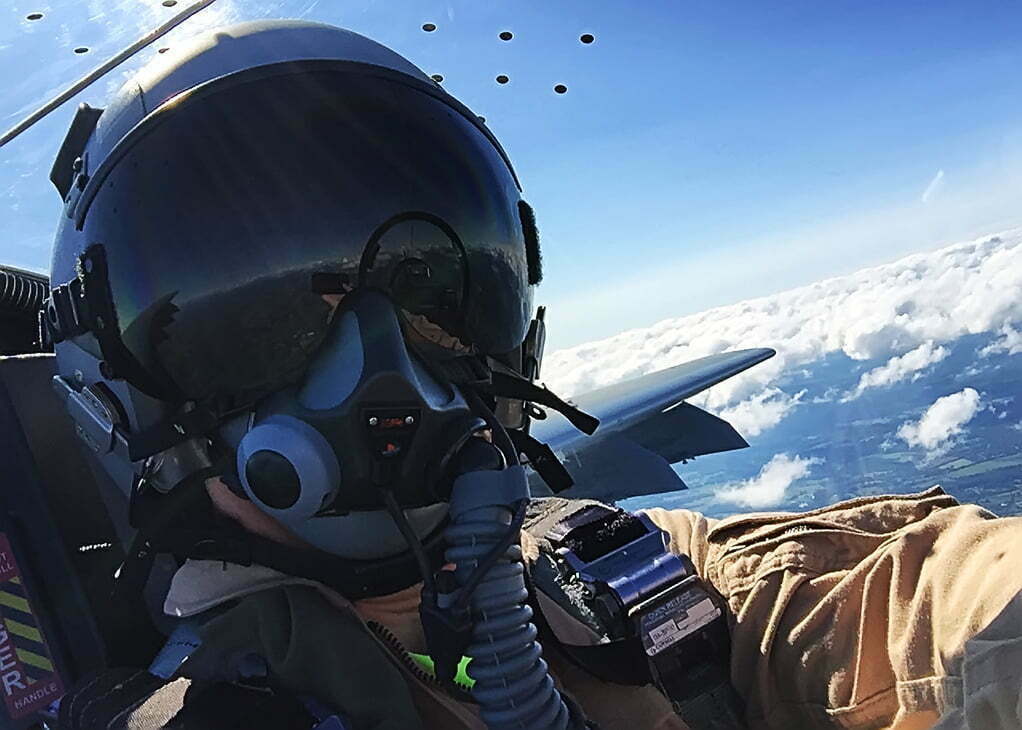
I recently flew in one of the three production Scorpions, “P2” fresh off the USAF OA-X Experiment. Textron Aviation Defense Flight Test and Demonstration Pilot Matt “Tajma” Hall (current Air National Guard C-130 Aircraft Commander; experienced pilot in the F-15E, and T-6) provided flight briefing, and Chief Test Pilot Dan “Shaka” Hinson (Ret. USN F/A-18 Pilot, former Commanding Officer of the U.S. Naval Strike Fighter Weapons School, and Graduate of U.S. Naval Test Pilot School) piloted the aircraft.
One cannot help but note the tremendous quality and experience in the team that Textron has assembled to not only fly and prove the aircraft, but to provide the intellectual capital behind design and capability.
Departing on an IFR flight plan in low overcast from the Manassas Regional Airport, Virginia, we quickly climbed to 5,000 ft and headed southwest where the skies were clearing.
The rapid departure and climb made it clear we were under jet power.
Within minutes we were in suitable VFR conditions over Charlottesville, Virginia and ATC provided a block of airspace for maneuvering.
Over the next 60 minutes, Hinson demonstrated the flight characteristics, sensors and weapons systems.
Under his watchful eye, Hinson had me take control of the aircraft executing turns, pulling Gs, evaluating high speed handling, speed brake deployment, an aileron roll, multiple stalls and stall recoveries. The Scorpion is an incredibly stable and “pilot friendly” aircraft.
Engines at idle, flaps up, stick back, and nose high – and the aircraft would not stall.
When parameters were established to create a stall, recovery was straightforward. The aircraft is slippery and a slight drop in the nose leads to a “with this kind of nose attitude the aircraft really accelerates a lot…” from Hinson. The man is a real professional, a gentleman’s way of saying, “pull the nose up.” I did.
The wing provides a tremendous glide ratio, ideal for the aircraft’s purpose – ISR in a permissive environment. On station at about 12,000 ft the total fuel burn was only 500 – 600 lbs per engine, per hour. This enables tremendous time on station with a variety of weapons at the ready to neutralize a target of opportunity.
For comparison sake, the fuel burn per hour on station is about 10 – 12% of the F-15E Strike Eagle and less than 20% of an F-16 in the same role. While no replacement for these fighter aircraft, this mission utilization is precisely how scores of hours have been accumulated by the F-15E, F-16, A-10, and F/A-18s over the past 30 years.
The Scorpion delivers exceptional economy while enabling operations from austere environments with very capable ISR payloads.
A veritable set of airborne eyes and ears, the Scorpion supports payloads that facilitate both kinetic and non-kinetic effects across all operational domains.
With significant internal space for payloads, the Scorpion offers an excess of electrical power to support anticipated and unforeseen demands.
A nose bay is available for configuration with electro-optical/infrared (EO-IR) sensors such as the L3 Wescam MX series, or an active electronically scanned array radar (AESA).
Three large internal payload bays can be configured for use with sensors/payloads to support Signals Intelligence (SIGINT), Synthetic Aperture Radar (SAR), Hyperspectral Analysis, Electronic Warfare or other.
Additional payloads such as a 4G LTE Hotspot could be very helpful in a humanitarian crisis.
Like a smartphone, the Scorpion’s capabilities are limited only by the ingenuity of providers to fill the space and power available.
Permissive environments that utilize significant ISR assets such as the RC-135 Rivet Joint [SIGINT], E-8 JSTARS [SAR] and others may find more than adequate capability in a rightly configured Scorpion.
Such downsizing of ISR packages would increase savings exponentially and free the most capable USAF assets for demanding mission sets.
Orbiting on station I found operating the sensor package while flying the aircraft via the Hands-on Throttle and Stick [HOTAS] intuitive and straightforward. Up front, Hinson utilized the Helmet Mounted Cueing System (HMCS) to demonstrate operational capabilities.
Specific sensor packages overlay data from multiple payloads and create a single situational picture captured by time and geolocation.
The data could be processed by a powerful computer package onboard, or streamed by secure network to other assets in space, the air or ground.
As Textron Aviation Defense Senior Advisor Stephen Burke indicated, “We can pull out of the noise a target that is very difficult to see. A low contrast, short dwell target in a chaotic urban environment.”
The kind of environment that the USAF has been operating in for years – with no end in sight.
The massive increase in data generated by ISR platforms has created very real manpower challenges for Processing, Exploitation and Dissemination (PED).


An onboard, algorithm-driven computer system would provide a tremendous leap in PED capability.
That kind of computer driven analysis of data is a capability USAF thought leaders have indicated is imperative.
The open architecture the Scorpion features for payloads is entirely separated from the aircrafts flight controls.
Each system/sensor simply runs as a unique application within the main mission systems computer.
This “non-proprietary” approach opens scores of possibilities for the user and their related contract negotiations.
While speaking at the OA-X experiment at Holloman AFB, Secretary of the Air Force Heather Wilson specified this approach (open architecture/non-proprietary) as a requirement to do business with the USAF moving forward.
When Scorpion payload providers update their sensors with additional capabilities scores of hours of regression testing can be avoided – reference the ICD, plug, play and deploy. Rather than take years to upgrade sensors, it can be achieved in weeks.
The excellent flight characteristics I experienced are complemented by tremendous reliability and ease of operations.
Whether in weapons testing, flight testing or international travel – the Scorpion has demonstrated exceptional readiness rates.
Most recently flying from Wichita, Kansas to the Dubai Air Show, “P2” visited nine countries in six days with 100 percent mission readiness. 100 percent readiness sounds fictitious.
However, it is not all that surprising given the aircraft utilizes proven and widely deployed commercial systems.
While visiting Saudi Arabia, Saudi Arabian Air Force pilots quickly qualified in the Scorpion and scored multiple direct hits with inert GBU-12s.
At the Dubai Air Show, the Textron team continued flight operations with multiple demonstrations showcasing Scorpion’s capabilities to an array of international prospective customers.
Unlike the USAF during the O-AX experiment, or the Saudi Arabian Air Force pilots, my flight demonstration carried no ordnance.
However, a target below was designated and Hinson demonstrated an attack profile with a precision guided munition.
The Scorpion features a proven Stores Management System [SMS] that will continue to grow as more ordnance is qualified for the aircraft.
Returning to the airfield, I had the time to appreciate the exceptional view, and the potential value the aircraft could bring to the growing USAF pilot shortage.
During the OA-X experiment, it was noted by USAF leadership that procurement of additional low-cost airframes would be required to surge pilot training/skills development to address the pilot shortage.
The Scorpion is a compelling fit for USAF pilots — and for USN pilots who graduate out of flight school.
Their first assignment in a Scorpion would expose them to a low cost but very capable platform that brings forward the future of the DoD operations.
Scorpion pilots will be immersed in the combat cloud, secure communications, fusion warfare, sensor operation and management.
I can think of no better platform for pilots to learn relevant systems and build hours while preparing for the power of the DoD’s upgraded Gen 4 and Gen 5 aircraft and the high intensity fight.
The Second Line of Defense expresses gratitude to the team at Textron Aviation Defense, specifically to the patient and gracious Chief Test Pilot Dan “Shaka” Hinson and Pilot Matt “Tajma” Hall. An exceptional team of professionals across the board.